
Pokazywanie postów oznaczonych etykietą East Central Europe. Pokaż wszystkie posty
Pokazywanie postów oznaczonych etykietą East Central Europe. Pokaż wszystkie posty
czwartek, września 24, 2015
Journey to former Polish East South borderland


wtorek, września 08, 2015
Poles and Hungarians and their place in Europe

Poles and Hungarians has a lot in common in the past. Their relationship gives a number of sources for scientific researches.
Poles and Hungarians shared rulers and faith. Common was also the Revolution of 1956, which was of course more tragic on the Hungarian side.
czwartek, marca 05, 2015
East-Central Europe
It is not easy to distinguish between East Europe and Central Europe. At the same time the local roots are very important. Despite people are changing, roots of changes and of the mentality can be seen in the past.
So what is East-Central Europe?
Oskar Halecki distinguished four regions in Europe (Western, West Central, East Central and Eastern Europe).

Author: Olahus CC BY-SA 3.0
So what is East-Central Europe?
Oskar Halecki distinguished four regions in Europe (Western, West Central, East Central and Eastern Europe).

Author: Olahus CC BY-SA 3.0
środa, lipca 31, 2013
Textbook "History and human rights"
KARTA Center published the textbook "History and human rights" and translated it into English. You can find the textbook here: http://bit.ly/15Oljrr. I'm the co-editor of the textbook.

środa, listopada 30, 2011
Monuments as a medium of remembrance
European Network Remembrance and Solidarity established in Warsaw supports since 2011 researches on genealogies of memory in Central and Eastern Europe.
It's first conference was dedicated to theories and methods. I gave there a paper on "Monuments and memory constructs in L'viv between 1867 and 1939". The programme of the conference you can download here.

It's first conference was dedicated to theories and methods. I gave there a paper on "Monuments and memory constructs in L'viv between 1867 and 1939". The programme of the conference you can download here.

wtorek, października 04, 2011
Network of cultural and civic activists - MitOst
The Society MitOst is a living network of cultural and civic activists in Eastern and Central Europe. Every year member meet at different cities in the region. A member can be everyone, who is interested in the culture and civic life in the region.
The meetings have the name "Festival" and have different topics. E.g. the 9th Festival of MitOst took place in České Budějovice from 28.9.2011 till 2.10.2011. The topic of this MitOst - Festival was new forms of engagement. There were many people who are engaged for a balanced life.

The meetings have the name "Festival" and have different topics. E.g. the 9th Festival of MitOst took place in České Budějovice from 28.9.2011 till 2.10.2011. The topic of this MitOst - Festival was new forms of engagement. There were many people who are engaged for a balanced life.

sobota, lipca 29, 2006
Popularisation of democratic values by the Theodor-Heuss-Kolleg
The Theodor-Heuss-Kolleg was a funding programme of Robert Bosch Foundation. This collegue supported popularisation of democratic values among young people from East Central Europe.
I was a member of the Theodor-Heuss-Kolleg from May 2005 till July 2006. The photos present the finish of the collegue in July 2006 in Berlin.
I was a member of the Theodor-Heuss-Kolleg from May 2005 till July 2006. The photos present the finish of the collegue in July 2006 in Berlin.
Eastern Europe on move
Project work is something very important for the personal development of young people. Students of Eastern and Central Europe could learn the project work in practice thanks to the Theodor-Heuss-Kolleg of the Robert Bosch Foundation.
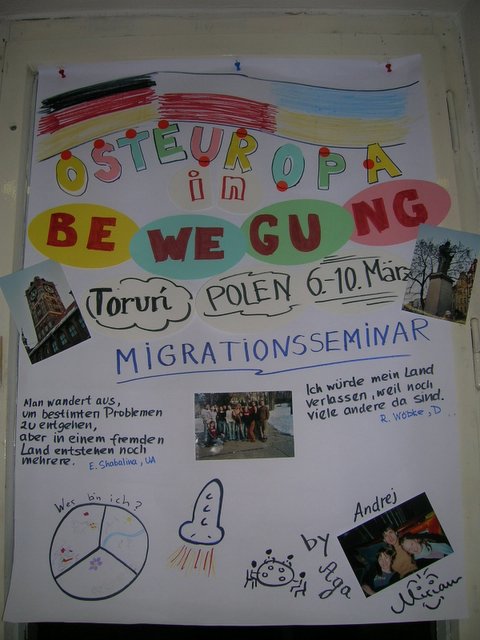
Me as a member of the Kolleg together with two other members conducted an German-Ukrainian-Polish seminar about Eastern Europe on the move in Toruń in March 2006.

Me as a member of the Kolleg together with two other members conducted an German-Ukrainian-Polish seminar about Eastern Europe on the move in Toruń in March 2006.

środa, lipca 26, 2006
Bologna process in Germany, Hungary and Poland
Students from almost all European countries should be interested in analyses of studies in Europe after the Bologna process.
The Polish Ministry of Science and Higher Education publishes a number of changes which are important for universities after the Bologna process.
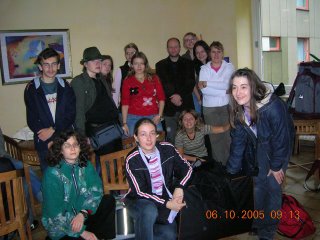 How it looks like in Germany, Hungary and Poland? Thanks to the cooperation between the Nicolaus Copernicus University, University in Göttingen and Szeged University in Hungary students of those universities could exhange their experiencies after the introduction of Bologna process at universities within a seminar.
The Polish Ministry of Science and Higher Education publishes a number of changes which are important for universities after the Bologna process.
 How it looks like in Germany, Hungary and Poland? Thanks to the cooperation between the Nicolaus Copernicus University, University in Göttingen and Szeged University in Hungary students of those universities could exhange their experiencies after the introduction of Bologna process at universities within a seminar.
Subskrybuj:
Posty (Atom)