Pokazywanie postów oznaczonych etykietą seminar. Pokaż wszystkie posty

wtorek, marca 25, 2014

Teaching human rights and history

Combining human rights and history education can be very useful. One of the common values for both fields is the change. If you analyse history you look mostly for the change and dealing with human rights aimes mostly at bringing change into life.

The Change is also a title of a book wich is being prepared by an international team of scientists in collaboration with practitioners of history education and human rights education. I will upload it here, when it will be finished (at the end of 2015 or at the beginning of 2016)

wtorek, maja 01, 2012

Memory places and culture of remembrance in L'viv

Remembrance culture and memory places in L'viv are more and more interesting as a research topic.

To give the students the opportunity of researches on the topic Prof. Jürgen Angelow (University Potsdam/University of the Saarland) organised a seminar on this topic in L'viv 2007 and 2012.

The topics were divided into 6 sessions:

wtorek, października 04, 2011

Network of cultural and civic activists - MitOst

The Society MitOst is a living network of cultural and civic activists in Eastern and Central Europe. Every year member meet at different cities in the region. A member can be everyone, who is interested in the culture and civic life in the region.

The meetings have the name "Festival" and have different topics. E.g. the 9th Festival of MitOst took place in České Budějovice from 28.9.2011 till 2.10.2011. The topic of this MitOst - Festival was new forms of engagement. There were many people who are engaged for a balanced life.


środa, sierpnia 17, 2011

German-Russian cooperation

German-Russian cooperation is supported on different ways.

One of the initiative is the Petersburger Dialog. It was initiated by the German Chancellor Gerhard Schröder and Russian president Wladimir Putin 2001 and it works till now. Since 2014 it is more and more criticized because of its political dependence.

The Petersburger Dialog consists of workgroups. Sometimes they invite to their meetings representatives of other nations.

sobota, lipca 29, 2006

Popularisation of democratic values by the Theodor-Heuss-Kolleg

The Theodor-Heuss-Kolleg was a funding programme of Robert Bosch Foundation. This collegue supported popularisation of democratic values among young people from East Central Europe.

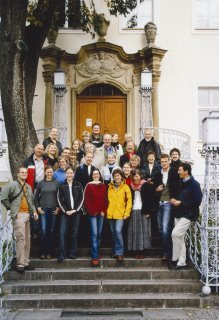
I was a member of the Theodor-Heuss-Kolleg from May 2005 till July 2006. The photos present the finish of the collegue in July 2006 in Berlin.

Training how to conduct a seminar

I recommend veryone to take part on trainings of every kind. Because I learnt to conduct an international seminar I took part on a training "How to conduct a seminar", which was organised by Theodor-Heuss-Kolleg of the Robert Bosch Foundation.

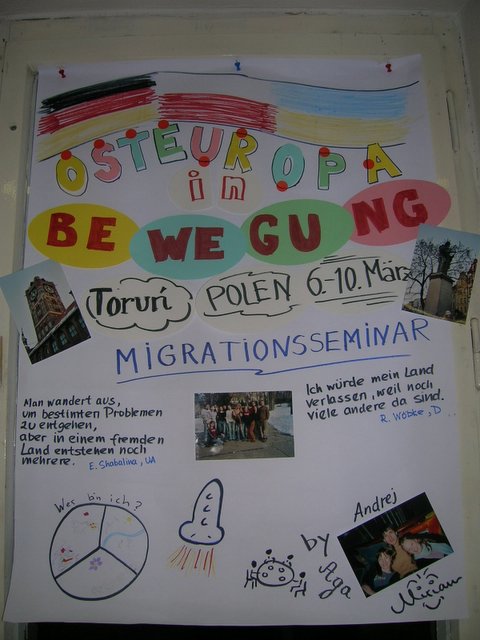
Eastern Europe on move

Project work is something very important for the personal development of young people. Students of Eastern and Central Europe could learn the project work in practice thanks to the Theodor-Heuss-Kolleg of the Robert Bosch Foundation.

Me as a member of the Kolleg together with two other members conducted an German-Ukrainian-Polish seminar about Eastern Europe on the move in Toruń in March 2006.

History of Śląsk / Silesia

History of the borderland on example of Śląsk / Silesia is very important for Poles, Czechs and Germans.

Prof. Angelow (University Potsdam) conducted a seminar related to the history of Śląsk / Silesia from the 18th till 20th century.
Seminar group in Krasków by Świdnica

czwartek, lipca 27, 2006

Difficult neighbourhood in Alsace and Lothringen

Relationships between France and Germany are called often as "difficult". Especially Alsace and Lothringen are the regions which caused conflicts.

So Prof. Jürgen Angelow and Prof. Bernhard Kroener (University in Potsdam) organised a seminar on the "difficult neighbourhood in Alsace and Lothringen in the 19th and 20th century". It took place at different places in Alsace and Lothringen in 2005.

I gave there a lecture about cardinal Richelieu's politics regarding other European countries.

 Posted by Picasa

środa, lipca 26, 2006

Bologna process in Germany, Hungary and Poland

Students from almost all European countries should be interested in analyses of studies in Europe after the Bologna process.

The Polish Ministry of Science and Higher Education publishes a number of changes which are important for universities after the Bologna process.

How it looks like in Germany, Hungary and Poland? Thanks to the cooperation between the Nicolaus Copernicus University, University in Göttingen and Szeged University in Hungary students of those universities could exhange their experiencies after the introduction of Bologna process at universities within a seminar.

czwartek, czerwca 08, 2006

The Balkans in the 19. and the 20. century

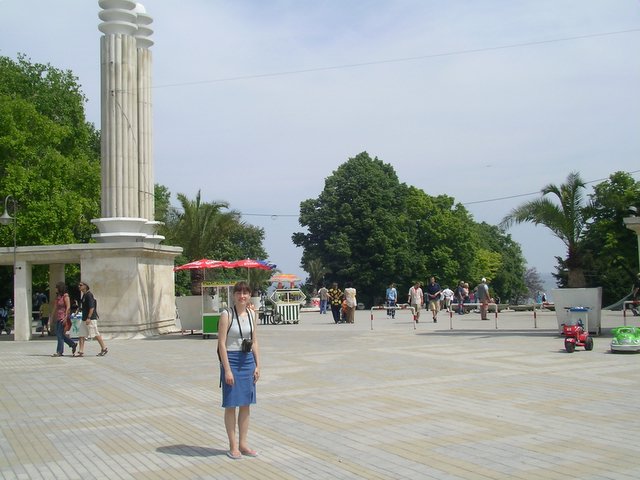
I took part on a seminar about the history of the relationships on the Balkan in the 19th and 20th century in Varna 2006. On the seminar took part students of history at the Potsdam university and Bulgarian history students.

If you are interested in history of the World War I on the Balkan, I recommend you this book: Der Erste Weltkrieg auf dem Balkan: Perspektiven der Forschung (2011)
 

It's me on the main square in Varna.